Click here to


Clothing Manufacturer in Bangladesh Since 1987
Click here to
Click here to

Click here to

Click here to

Click here to

Click here to

Click here to
Click here to

Click here to

Click here to

Click here to
A Dutch promotional distributor, corporate buyer or merchandise importer usually needs a T-shirt specification that can be reproduced consistently across colours, sizes and branding applications. The commercial requirement may be simple, such as a company logo on the chest, or more detailed, including custom labels, multiple print locations, branded packaging and a specific fabric weight.
SiATEX manufactures custom apparel in Bangladesh for export markets. Its Netherlands related production pages describe made-to-order T-shirts, custom printing, embroidery, labels, Pantone-matched colours and several fabric choices.
The general MOQ for this order structure is 3,000 pieces per order, with a mix of 4 colours and 3 styles in one fabric type. This is relevant to buyers who want several branded T-shirt variations without developing a separate fabric programme for every style.
For a Netherlands order, the most useful starting point is the finished product specification rather than a generic request for "promotional T-shirts."
Brand promoting T-shirts for Netherlands
A promotional T-shirt can be manufactured in different fabric constructions depending on how the garment will be used.
100% cotton is suitable for conventional casual promotional merchandise where a cotton hand feel is required.
Polyester or cotton-polyester blends can be considered when the buyer needs different durability or performance characteristics.
Organic cotton may be specified when the purchasing programme requires certified organic fibre.
Polyester performance fabrics can be relevant for sports campaigns, outdoor promotions and activewear-related events.
SiATEX's Netherlands pages list 100% cotton, poly/cotton, melange and cotton/spandex among available fabric choices, while another Netherlands promotional T-shirt page lists cotton, polyester, blends, Dri-fit and organic cotton options.
GSM should be stated in the technical specification. A 160 GSM T-shirt and a 220 GSM T-shirt should not be treated as interchangeable simply because both are cotton. Fabric weight influences the garment's drape, appearance, material consumption and ultimately the quotation.
The buyer should also specify whether the fabric needs a particular finish, shrinkage tolerance or colour standard.
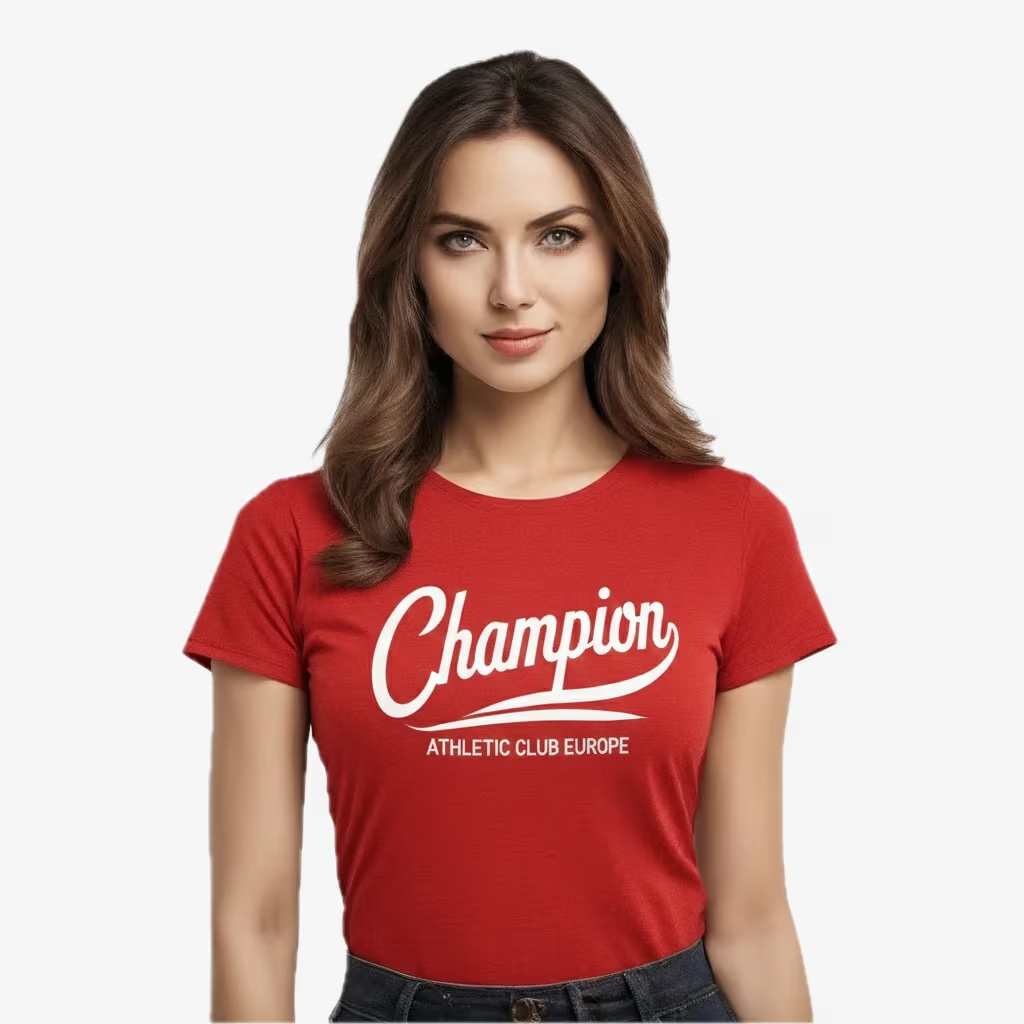
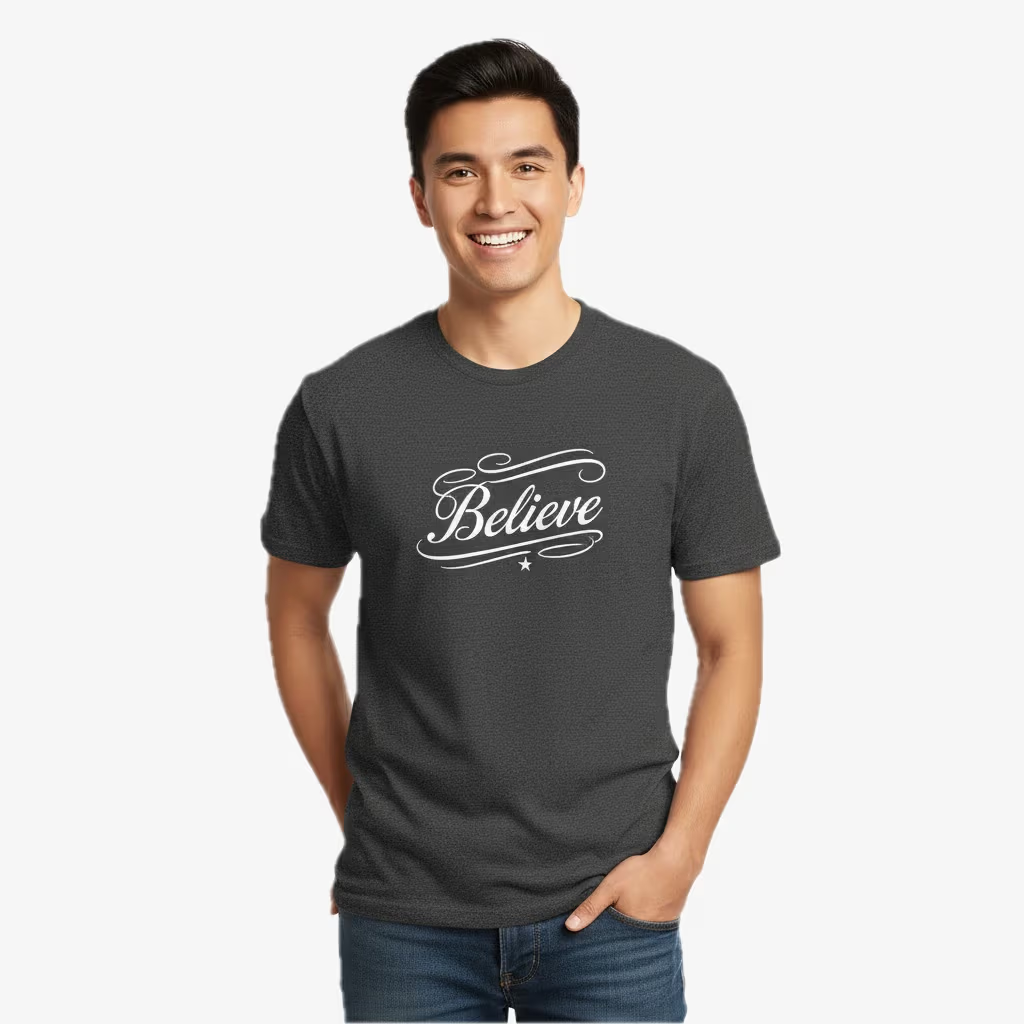
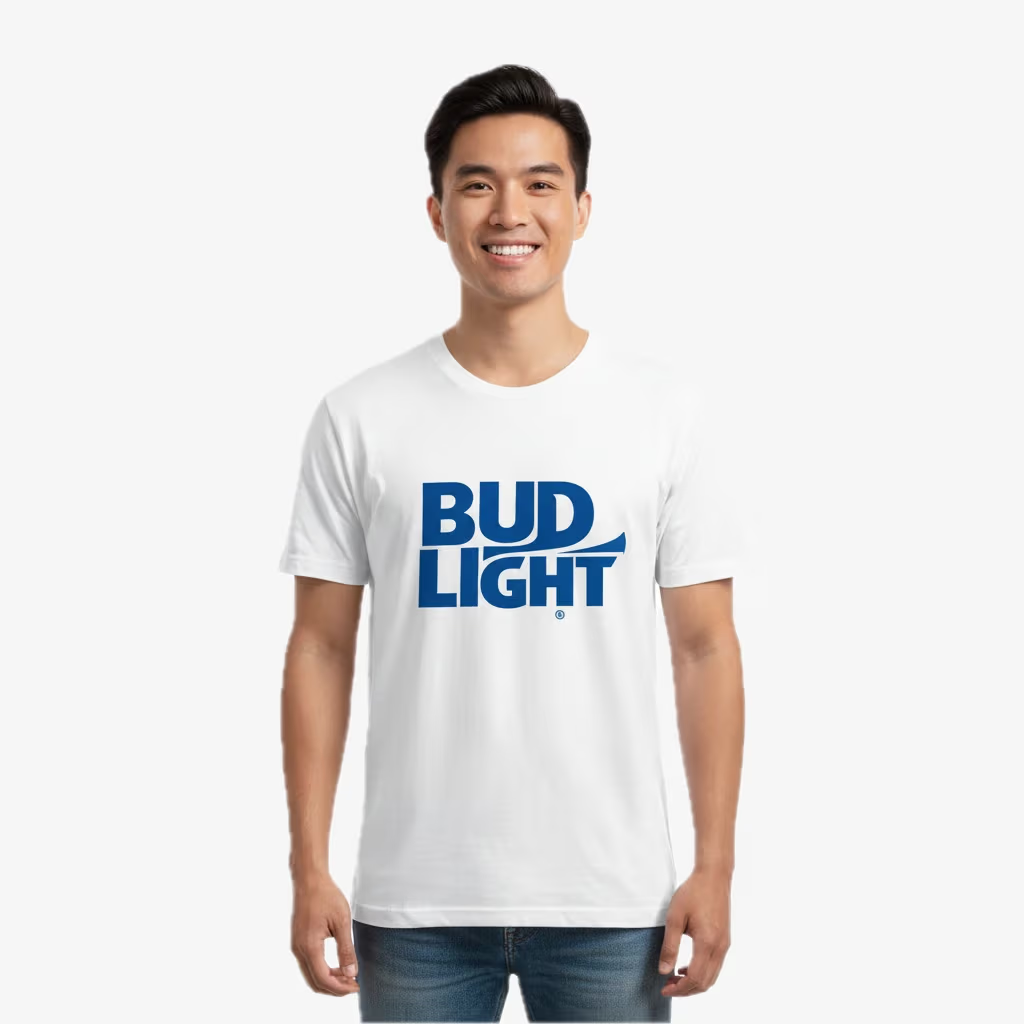
For brand promotion, the decoration method needs to match the artwork and fabric.
Screen printing is commonly used for logos, lettering and graphic designs, particularly when the same artwork is required across a substantial quantity.
Embroidery is appropriate for selected logos and smaller branded details where stitched decoration is preferred.
Sublimation is suited to polyester garments and can support full-colour or all-over designs.
Heat transfer can be considered for certain detailed graphics and branding requirements.
SiATEX lists screen printing, embroidery and sublimation among its customisation options for Netherlands T-shirt production.
The artwork specification should identify the exact print location. A left-chest logo, centre-front graphic, back print and sleeve print require different production planning.
The buyer should provide the artwork file, print dimensions, colour references and placement measurements. A physical sample or approved pre-production sample can then be used to establish the intended appearance before bulk manufacturing.
Custom printed T-shirts for Dutch promotional campaigns
The general SiATEX MOQ is 3,000 pcs per order, allowing a mix of 4 colours and 3 styles while retaining one fabric type.
A Dutch importer could therefore structure a programme around several related garments, for example:
| Order parameter | General structure |
|---|---|
| Total quantity | 3,000 pcs |
| Colours | 4 |
| Styles | 3 |
| Fabric types | 1 |
The final allocation needs to be confirmed against the actual styles, sizes, colours and decoration requirements. The MOQ should not be interpreted as an automatic minimum for every individual colour or design.
Keeping one fabric type across the programme can also simplify material planning. However, different styles may still require different patterns, trims, measurements or sewing operations.
Buyers should provide the quantity breakdown by style, colour and size when requesting a quotation. Without that breakdown, the supplier cannot accurately assess the production mix.
Brand promoting T-shirts can serve different purchasing purposes, and each use case can change the specification.
A company exhibiting at a trade fair may require a clear front logo, employee size assortment and delivery before the exhibition date.
An advertising agency may order shirts for a product launch and need several colourways carrying the same campaign identity.
A sports sponsor may require larger graphics, performance fabric or additional branding locations.
A merchandise distributor may need private labels, individual polybags, barcodes and carton-level identification because the garments will enter its own fulfilment system.
A retail brand can use the same manufacturing route but may place greater emphasis on fabric hand feel, fit, construction, labels and packaging.
Private label T-shirt manufacturing for Netherlands buyers
The supplier should know which of these commercial applications applies before the sample is developed. A garment designed as event merchandise does not necessarily need the same construction or finishing as a T-shirt intended for retail sale.
Corporate branding often depends on consistent colours. If the garment itself is part of the brand identity, the buyer should provide a defined colour reference rather than relying on a verbal description such as "dark blue."
SiATEX's Netherlands corporate-wear information states that Pantone-matched dyeing is available.
Logo colour should also be specified separately from garment colour. The same print ink can look different against different fabric shades, while a garment colour can vary depending on the dyeing process and fabric construction.
For a new colour programme, buyers may request a lab dip or colour approval sample before bulk dyeing. The approved reference should be retained for production comparison.
A finished promotional T-shirt has two separate quality areas: the garment and the branding.
Garment inspection can cover fabric defects, measurements, seams, neckline, sleeves, hems and loose threads. Decoration inspection should cover print position, dimensions, colour, registration and surface quality.
Labels and packing require their own checks. Incorrect size labels or mixed cartons can cause problems after shipment even when the garments themselves meet the approved specification.
SiATEX's Netherlands pages describe quality and compliance controls and state that its production uses OEKO-TEX certified fabrics and facilities complying with BSCI and WRAP standards on relevant offerings.
Certification requirements should nevertheless be confirmed against the actual factory, material and order. A buyer requiring a named certification should request the applicable documentation rather than relying on a general statement about compliance.
The Netherlands is an EU market, so textile products placed on the EU consumer market are subject to EU textile labelling rules.
The European Commission states that textile products sold to consumers in the EU must identify their fibre composition using the prescribed fibre names and percentages. The label must be durable, legible, visible and accessible.
For a T-shirt containing multiple textile fibres, the composition needs to be declared according to the applicable rules. The buyer should therefore approve the final fibre composition before the neck label and care label are produced.
Language requirements also matter. The EU guidance states that textile labelling information must be provided in the official language or languages of the country where the product is made available to consumers, subject to applicable national rules.
If the same T-shirt will subsequently be distributed in Germany, France, Italy, the UK or other markets, the buyer should review the applicable destination requirements rather than assuming one label will satisfy every market.
Custom T-shirt production has several stages before the sewing line starts. The schedule may include artwork review, sample development, fabric selection, colour approval, label production and packaging approval.
SiATEX's Netherlands production information describes a process in which buyers provide a design, tech pack or reference sample, receive a custom sample, approve it and then proceed to bulk production.
For a campaign tied to a specific date, the purchasing schedule should include time for corrections. A sample that requires changes to fit, fabric, artwork or print placement can extend the overall programme.
The buyer should provide:
The final lead time should be confirmed for the actual order rather than copied from a generic product page.
Custom T-shirt production for Amsterdam buyers
For brand promoting T-shirts, the unit price is influenced by several production variables.
Fabric composition and GSM affect material consumption. Garment construction affects sewing time. Number of colours in the artwork can affect printing setup. Multiple print locations increase decoration operations. Custom labels, hangtags and individual packaging add separate material and labour costs.
Order quantity also matters, but comparing two quotations solely by price per piece can be misleading.
A proper comparison should use the same:
A quotation for a plain T-shirt with one chest print is not directly comparable with a private-label garment carrying front and back prints, custom tags and retail packaging.
Dutch buyers sometimes source for more than the Netherlands. A promotional distributor may supply clients in Belgium, Germany or other European markets, while an international brand may use the same Bangladesh production base for campaigns extending into the USA, Canada, Australia or Saudi Arabia.
The manufacturing specification should remain destination-specific where labelling, packaging or regulatory requirements differ.
Custom apparel manufacturing for the Netherlands
For EU distribution, the fibre composition and required textile information should be established before production. For non-EU destinations, the importer should separately confirm the relevant market requirements.
A Dutch buyer requesting a quotation should send enough information for the manufacturer to price the actual garment.
The enquiry should contain the T-shirt style, fabric composition, GSM, colour references, size range, quantity by colour and style, logo artwork, decoration method, print locations, labels, packaging and required delivery date.
If the buyer has a reference garment, include its measurements and construction requirements or provide the physical sample where appropriate. A photograph alone may not show neckline construction, fabric weight, seam type or fit accurately.
Wholesale branded T-shirts from Bangladesh
For the general 3,000-piece MOQ, the order can be planned around four colours and three styles while maintaining one fabric type. The final production plan should be confirmed after the supplier reviews the complete specification.
That approach gives a Netherlands importer a usable quotation, a measurable sample approval process and clearer control over the garment that eventually reaches the customer or promotional campaign.
